
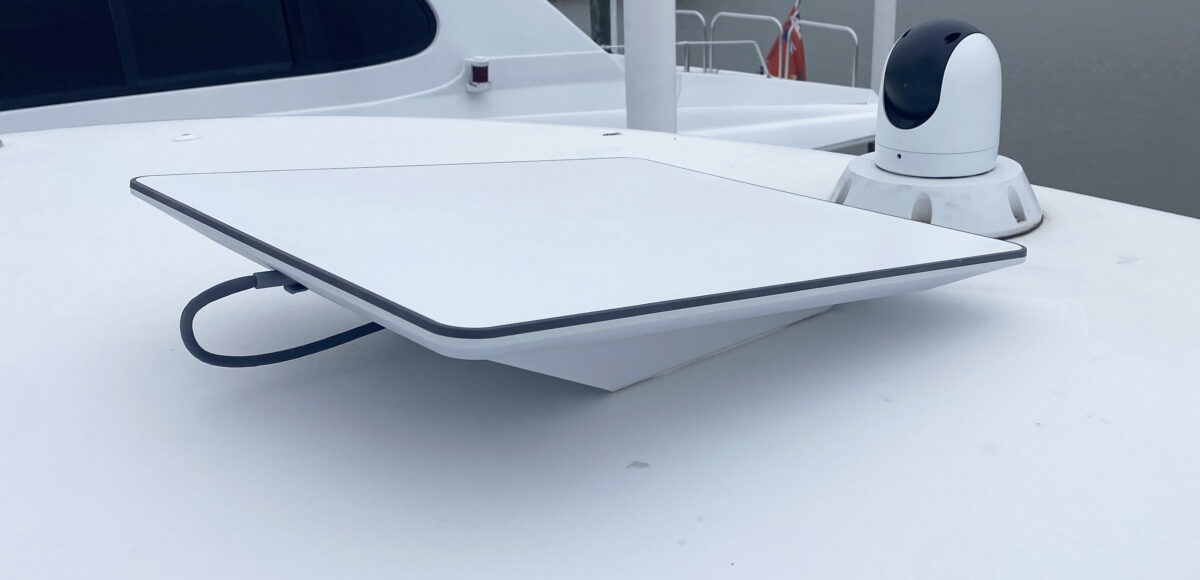
Starlink for boats, installed on Long Island.
We install Starlink for boats — mounting, cabling, and configuring Starlink Maritime and Starlink Mini systems on boats across Nassau County and Suffolk County.
Marine satellite internet for navigation apps, weather routing, video calls, remote vessel monitoring, and streaming — no dead zones once you leave the dock. Low Earth orbit satellites mean real broadband, not the slow satellite of the past.

Why Starlink for boats is different from every other marine satellite internet option.
Traditional satellite internet for boats — KVH, ViaSat — uses geostationary satellites 22,000 miles above Earth. The distance creates 600ms+ latency. You can browse email but forget video calls or real-time weather data.
Starlink uses a constellation of Low Earth Orbit satellites at 340 miles altitude. The result is 20–60ms latency — comparable to a cable connection at home. Download speeds of 50–250 Mbps are typical on the water around Long Island Sound and the Atlantic coast.
The flat phased-array antenna automatically tracks satellites without mechanical movement. It self-levels, self-orients, and maintains lock even while the boat is underway — as long as you have an in-motion capable plan and hardware.
For Long Island boaters, this is a meaningful upgrade. Whether you're crossing Long Island Sound to Connecticut, running the Block Island race, or fishing the canyons 100 miles offshore, Starlink provides consistent broadband where cellular signal stopped long ago. Real-time weather data from SiriusXM, Zoom calls from the anchorage at Shelter Island, vessel monitoring from your phone while the boat sits on the mooring — all of it is practical with Starlink in a way it never was before.
- 20–60ms latency — usable for Zoom, Facetime, real-time weather routing
- 50–250 Mbps typical download speed on the water
- No mechanical dish to maintain or replace
- Automatic satellite acquisition — powers on and connects in minutes
- Coverage across Long Island Sound, the Atlantic coast, and offshore to 200nm+


Which Starlink kit is right for your boat?
Starlink Mini
11 x 10 inch compact flat antenna. Lightest unit at under 2.5 lbs — ideal for smaller boats, center consoles, and tenders where space and weight matter. Requires a flat, unobstructed mounting surface. Starlink lists the Mini as supported for in-motion use on the right plan.
- Best for: boats under 28ft, day boats, console boats
- Power draw: ~25–30W
- Weight: 2.4 lbs
Starlink Standard
The most popular choice for recreational boaters. 19 x 12 inch flat antenna, in-motion capable with a Roam plan (in coastal and inland waters) or a Maritime plan. Handles speeds up to 200+ Mbps. Pipe mount or flat surface mount — we fabricate marine-grade stainless mounting hardware for any installation.
- Best for: express cruisers, sportfishing 28–45ft, liveaboards
- Power draw: ~50–75W
- Weight: 4.5 lbs
Flat High Performance
24 x 16 inch high-performance flat antenna — designed for demanding maritime environments, faster speeds, and better performance in heavy weather. Built-in heating for icing conditions. The right choice for offshore vessels, charter boats, and yachts over 45ft.
- Best for: yachts 45ft+, offshore fishing, charter vessels
- Power draw: ~100–150W
- Weight: 9.2 lbs
What a Starlink installation on your boat includes, start to finish.
Starlink installs look simple on YouTube. In practice, a proper marine installation means UV-rated cable management, waterproof cable penetrations, 12V power conversion, and router placement that doesn't cook in the engine room. We handle every part of it.
Antenna Mounting
We fabricate or source a proper stainless or marine-grade aluminum mount for your T-top, arch, hardtop, or radar arch. The antenna needs a clear 100-degree sky view — we site it correctly so you don't lose signal from your own rigging.
Cable Run
The Starlink cable is a single proprietary cable — it cannot be extended without a proper junction box. We route it through conduit or existing cable pathways, seal all penetrations with marine-grade fittings, and protect the run from UV and chafe.
Power Setup
Starlink hardware runs on 12V but ships with a 110V wall adapter. We wire the system direct to 12V using the appropriate DC-DC converter and properly rated fuse, so it runs off your boat's battery system without needing shore power or an inverter.
Router Placement & Network
The Starlink router goes inside the cabin in a ventilated location. We configure the WiFi network, set up the Starlink app on your devices, and test download/upload speeds before we're done. Optional: network integration with onboard switch for wired connections.
Plan Activation Support
We help you select the right Starlink plan — Maritime for in-motion use, or Roam for dock, anchorage and coastal use. We activate the service on your account and confirm everything is working before we leave the boat.
ABYC-Compliant Wiring
Every wire run uses tinned marine-grade wire, waterproof connectors, and properly rated fuses — same standards we apply to every installation. No automotive wire, no crimp connectors that corrode in the marine environment.
Installing Starlink on a boat yourself: what works, and where it goes wrong.
Most people searching for Starlink for boats are weighing the same question: order the kit and do it over a weekend, or have it installed. Here is the honest version from the person who gets the call when the weekend version stops working.
What you can do yourself
A Starlink Mini on a center console or day boat is a fair weekend job: a rail or hardtop mount, a 12 V supply that meets Starlink's spec, the app, and a careful look at what will shadow the dish. Keep the cable in one piece and the router dry and you are most of the way there.
Where the weekend install goes wrong
The cable gets cut, spliced or extended; it is proprietary and does not take a splice. The dish ends up behind a radar dome or outriggers and drops out. The wall adapter runs off an inverter and the batteries are flat by morning. The hardtop hole is sealed with the wrong sealant and leaks into the headliner. The router cooks in the engine room. Nothing is fused.
What a professional install adds
A stainless mount sited for a clear sky view, a sealed penetration, a DC-DC converter sized for the kit on its own fused circuit, cable protected from UV and chafe, the router placed where it can breathe, the network configured, and speeds tested before we leave. Most boats are one day: $280 for the first hour, then $140 an hour, travel inside 30 minutes included.
Already have the kit? We install it at your slip. Not sure which one to buy? Start with the buyer's guide below, or call 516-448-6221.
Starlink for boats: two recent installs on Long Island.
This is what a Starlink installation looks like on a real Long Island boat. Two jobs from this year: a Starlink Mini on a hardtop in Merrick, and a Starlink system on a center console in the Town of Babylon. Every boat is laid out differently, so every install is a little different. These show the kind of work you're paying for.

Starlink Mini on a Boston Whaler 325 Conquest — Merrick
A 2023 Whaler 325 Conquest at a private dock in Merrick. We mounted the Starlink Mini on the hardtop and brought its cable inside through a SeaView watertight cable gland. The run goes behind the headliner, down to the helm.
It runs on the boat's own 12-volt power, on its own fuse, with a Bluetooth remote on/off switch — so it can be shut off without hunting for a breaker. The headliner and ceiling panel went back up with the wiring hidden.
Time on the boat: just under six hours.


Starlink on a Regulator center console — Town of Babylon
A Regulator with twin outboards, kept at a residential canal dock on the South Shore. The dish went up on the T-top, next to the radar.
The Starlink router and its power supply are mounted on the bulkhead inside the console, above the batteries.


Planning Starlink for your boat?
The mount, the cable path and where the power comes from all depend on your boat's layout. Tell us the boat and where it's kept, send a photo of the hardtop, T-top or arch, and we'll tell you what your install involves. When you call LIME, you're calling the person doing the work.
Ready to talk? Or keep reading below.
Starlink for boats: what it costs, which kit to buy, and what the install involves.
Most people searching for Starlink for boats want the same four answers before they spend anything: which kit fits my boat, what does the monthly service cost, what does a proper install look like, and do I even need it. Here they are in plain language. Plan prices below are as of September 2026 and come straight from starlink.com — check there for current pricing before you order, because Starlink changes it.
Which Starlink for boats fits your boat?
Starlink sells three kits that matter for boats. The short version is to match the kit to the size of the boat and to what your batteries can carry. Full sizes, weights and power draw are in the Hardware Options cards above. Starlink lists the Mini, the Standard and the Performance kits as supported for use while the boat is moving, on the right plan.
Center consoles and day boats
A Starlink Mini is usually the right fit. It is small and light, it draws the least power, and it sits comfortably on a T-top, hardtop rail or leaning-post frame. Good for bay, Sound and inshore fishing trips where you want maps, weather and streaming at the dock or the anchorage.
Typical boat: under about 28 feet.
Cruisers and sportfishers
A Starlink Standard is the usual pick. A bigger antenna means steadier speeds for video calls and several devices at once, and it mounts well on a hardtop, arch or radar pole. On boats without a generator we check your power budget first, because the Standard draws more than the Mini.
Typical boat: about 28 to 45 feet.
Yachts, charter and offshore boats
The Starlink Performance kit, which some dealers sell as the Flat High Performance, is built for permanent installation. It has an aluminum enclosure, runs on AC or DC power and carries a 3-year warranty from Starlink. It pairs with the Maritime plan for offshore work.
Typical boat: 45 feet and up, or any boat that runs offshore regularly.
Starlink for sailboats
Sailboats are the trickiest because rigging throws shadows and the boat heels. The antenna needs a wide, clear view of the sky, so we look at the stern rail, a radar pole, a solid arch or a dedicated mast-side mount and pick the spot where the boom, backstay and solar panels block the least. A Mini often fits a sailboat well because it is light, it draws little power and it is easy to remove and store. Power is the other half of the job. We wire it straight to your 12V system with a proper fuse, and we look at your battery bank and solar so Starlink does not flatten it overnight.
What Starlink plans cost for a boat
There are two families of plan. The Roam plans work on boats in coastal and inland waters, out to 12 nautical miles from shore, and cover nearly every Long Island Sound, bay and South Shore trip. The Maritime plans, which Starlink sells as Global Priority, are for regular ocean use beyond that. Prices are "starting at" monthly figures as of September 2026.
| Starlink plan | Starting at, per month | Who it suits |
|---|---|---|
| Roam 100GB | $55 | Occasional weekends at the dock or anchorage |
| Roam 300GB | $80 | Regular boating, several trips a month |
| Roam Unlimited | $175 | Heavy use, live-aboard style, lots of streaming |
| Maritime Global Priority 50GB | $250 | Ocean use, backup connectivity |
| Maritime Global Priority 500GB | $650 | Small commercial or charter operations |
| Maritime Global Priority 1TB | $1,150 | Busier commercial vessels |
| Maritime Global Priority 2TB | $2,150 | Large crews and heavy data needs |
With Roam 100GB and 300GB you get unlimited low-speed data after you use up your high-speed allowance, and Roam lets you pause service in Standby Mode for the off-season. Global Priority drops to about 1 Mbps download once the priority data is used. Most recreational boaters on Long Island are well served by a Roam plan. Source: Starlink Roam and Starlink Maritime, checked September 30, 2026. Check starlink.com for current pricing.
What a clean Starlink install involves, and what LIME charges
A clean install comes down to three things: where the antenna goes, how the power and cable get there, and whether it will still be watertight in three years. The common mounts are a flat mount on a hardtop or T-top, a rail or pole mount, a ratchet or quick-disconnect base you can remove for storage, and a fabricated stainless bracket on an arch. Power is hardwired to your boat's 12V DC system through a fused feed, not run off a shore-power brick and an inverter. The cable is routed through existing pathways or conduit and every penetration is sealed. The section above walks through each step.
LIME supplies the Starlink kit and the mounting hardware, billed at cost plus markup. Labor is time and materials: $280 for the first hour, which includes up to 30 minutes of travel each way and setup, then $140 an hour in 15-minute steps. There is no minimum. Travel beyond 30 minutes each way is $40 per half hour per man, door to door. How many hours it takes depends on the boat, and cable routing is the biggest variable, so any dollar figure is a rough guide and not a fixed price. You pay Starlink directly for the monthly plan.
Do you need Starlink, or will a cellular booster do?
If you mostly stay inside about 10 miles of shore, a cellular booster can be the smarter spend. We lay out the difference side by side in the Starlink for boats vs cellular boosters section just below. We install both.
When you are ready, LIME does the whole job: kit, mount, wiring, router and plan setup, on your boat, at your marina anywhere from Freeport to Montauk and Sag Harbor.
Starlink for boats vs cellular boosters — which do you need?
Both have a place. Starlink is not always the answer — here's how to think about it.
| Feature | Starlink Maritime | LTE Booster (Pepwave) |
|---|---|---|
| Coverage offshore | ✓ Excellent — works 200nm+ offshore | Limited — drops out 5–15mi offshore |
| Speed | 50–250 Mbps | 10–100 Mbps inshore |
| Latency | 20–60ms — video calls work | 20–50ms inshore |
| Monthly cost | from $250/mo (Maritime plan) | Carrier data plan — often cheaper |
| Hardware cost | $250–$599 hardware + install | $200–$600 router + install |
| Best for | Offshore, blue water, liveaboards | Coastal, marina, inshore fishing |
For most Long Island boaters who stay within 10 miles of shore, a quality Pepwave or WeBoost LTE system is the smarter investment. If you run offshore regularly, go to Block Island or beyond, or need internet on a passage — Starlink is worth every dollar. We install both.
Starlink installs from Freeport to Montauk.
We come to the boat, so the service area is really just how far we drive. Along the South Shore that means Freeport, Amityville, Lindenhurst, Babylon, Islip and Patchogue — the Great South Bay marinas, where a Starlink usually goes on a T-top or hardtop and the boat runs out an inlet to fish.
On the North Shore we cover Huntington, Northport and Port Jefferson, working off Long Island Sound. Out east we work Sag Harbor, Shelter Island, Greenport, Montauk, Southampton, Westhampton, Hampton Bays and East Hampton. The East End boats are the ones that benefit most from satellite, because that is where the cell signal runs out first.
If your marina is not named here, ask anyway — this is where we already work, not a boundary. For the county view, see Suffolk County marine electronics or Nassau County marine electronics.
Five-star reviews from Long Island boat owners.
★★★★★
Had LIME install Starlink Standard on my Grady-White 306 with a custom stainless arch mount. They wired it direct to 12V so it runs off the batteries — no inverter, no shore power needed. The whole job was clean and professional. Signal is rock solid from the dock to 80 miles out.
— Mike R., Grady-White 306
★★★★★
Starlink Mini on my 24ft center console — LIME mounted it flush on the T-top and ran the cable through the hardtop conduit so there's no exposed wire anywhere. Fits perfectly, barely notice it's there. Used it on a trip to Montauk with perfect streaming the whole way.
— Dan K., Scout 245 XSF
★★★★★
I asked LIME whether I needed Starlink or a Pepwave LTE setup for my boat — they were honest that for my use (mostly inshore, occasional Block Island run) the LTE router was the smarter call. They installed it perfectly. I respect that they gave me the right answer instead of selling me the bigger ticket item.
— Chris M., Mako 21 LTS
Long Island boat owners consistently leave LIME 5-star reviews.
Frequently asked questions
Which Starlink plan do I need for a boat?
For in-motion use offshore, you need the Maritime (Global Priority) plan, which starts at $250/mo as of September 2026 (check starlink.com for current pricing). Roam plans work on boats in coastal and inland waters up to 12 nautical miles from shore (starlink.com/us/roam, checked September 30, 2026); for regular ocean use beyond that, the Maritime (Global Priority) plan is the one to have. We'll walk you through the plan options during the install consultation.
Where do you mount the Starlink dish on a boat?
The ideal location is the highest, most open mounting point with 100-degree unobstructed sky view — typically a T-top, radar arch, hardtop, or flush on the cabin roof. We survey your boat and recommend the best position before any drilling. We fabricate stainless mounting hardware to match your boat's existing structure.
How much power does Starlink draw on a boat?
The Standard dish draws 50–75W at the antenna, plus another 15–25W for the router. Plan for 70–100W total continuous draw. This is significant for boats without a generator or large lithium bank. We assess your power budget as part of the install — Starlink on a light battery system may require a lithium upgrade or solar charging.
Does Starlink work in Long Island Sound and offshore?
Yes — Starlink provides excellent coverage in Long Island Sound, around the coast, and offshore to 200+ nautical miles on the Maritime plan. Signal quality is consistent in the area. Heavy rain can cause brief outages (same as home Starlink), but performance is far superior to any cellular solution beyond 10 miles offshore.
How long does a Starlink installation take?
Most Starlink installs take 3–5 hours depending on the boat layout and cable routing complexity. We include the survey, mount fabrication, cable run, 12V power wiring, router setup, and final speed testing in that time. Billed at $280 for the first hour (travel included), then $140/hr.
Will Starlink interfere with my existing marine electronics?
No — Starlink is a receive/transmit system operating on Ku/Ka band frequencies that don't interfere with VHF radio, AIS, GPS, or radar. The router creates a standard WiFi network. We integrate it carefully so it doesn't introduce noise into your NMEA 2000 network. If you have NMEA 2000 or Ethernet onboard, we can tie Starlink into the boat's network for wired access at the helm.
Can I use Starlink on multiple boats or move it seasonally?
Yes — a Roam or Maritime plan lets you use the hardware at different locations and pause service when the boat is out of the water for the season. The hardware is yours. We can also set up a quick-disconnect mount so you can remove and store the dish during storage season.
How much does Starlink cost for a boat?
Three separate costs. The kit is priced by Starlink, so check starlink.com for the current price. The monthly plan starts at $55 for Roam 100GB, $80 for Roam 300GB and $175 for Roam Unlimited as of September 2026, and Maritime plans start at $250 a month. The install with LIME is time and materials, $280 for the first hour and $140 an hour after that in 15-minute steps, plus the kit and mounting hardware at cost plus markup.
What are the monthly Starlink plans for boats?
As of September 2026, Starlink Roam plans start at $55 a month for 100GB, $80 for 300GB and $175 for unlimited, and work in coastal and inland waters out to 12 nautical miles. Maritime (Global Priority) plans for ocean use start at $250 a month for 50GB, $650 for 500GB, $1,150 for 1TB and $2,150 for 2TB. Check starlink.com for current pricing.
Can I put Starlink on a sailboat?
Yes. The job is finding a mounting spot on the stern rail, a radar pole, an arch or a mast-side mount where the rigging and boom block as little sky as possible, then wiring it to your 12V system with a proper fuse. The Starlink Mini is a common choice because it is light and draws little power. We also check your battery bank and solar so the dish does not drain it.
Do I need the Maritime plan, or will Roam work on my boat?
For most Long Island boats a Roam plan is enough. Roam works on boats in coastal and inland waters up to 12 nautical miles from shore, which covers the Sound, the bays and the South Shore. If you regularly run beyond that, offshore or on passages, you need a Maritime (Global Priority) plan, which costs more per month.
Can you use Starlink on a boat?
Yes. Starlink works on boats in coastal and inland waters on a Roam plan, which Starlink supports up to 12 nautical miles from shore, and offshore on a Maritime (Global Priority) plan. The kit is the same one sold for home or RV use; what makes it a boat installation is the mount, the 12 V power conversion and the cable run. Around Long Island that covers the Sound, the bays, the South Shore and the run to Block Island. The canyons need the priority plan.
What is the best Starlink for a boat?
For a center console or day boat under about 28 feet, the Starlink Mini: light, small, about 25–30 W. For cruisers and sportfishers from 28 to 45 feet, the Starlink Standard, about 50–75 W, steadier for video calls and several devices at once. For yachts over 45 feet, charter boats and regular offshore running, the Flat High Performance, about 100–150 W, with built-in heating. The limit is usually your battery bank, not the antenna, so match the kit to what the boat can power at anchor.
What are the disadvantages of Starlink on a boat?
Four honest ones. Power: a Standard kit pulls 50–75 W all day, a real load on a boat sitting on the hook without solar or a generator. Cost and plan rules: the monthly fee is more than a cellular plan, Roam stops at 12 nautical miles, and priority data beyond that costs more. The cable: it is proprietary and cannot be cut, spliced or casually extended, so the route has to be right the first time. Sky view: a radar dome, outriggers or a tower in the way means dropouts, and heavy rain can slow it. Most of these are solved by the installation, not the hardware, and the service can be paused over the winter.
What is the best Wi-Fi option for boats?
It depends on where you run. If you stay within about 10 miles of shore on Long Island, a cellular router with a marine antenna (Pepwave or weBoost) is often the cheaper answer and works at every marina. If you go offshore, to Block Island or on passages, Starlink is the only option that keeps working. Many boats now run both, with the router switching to cellular when it is strong and to Starlink when it is not. The comparison table above sets the two side by side, and we install either.
Answers written by Davanand Ramroop, NMEA Certified Marine Electronics Installer (MEI) at Long Island Marine Electronics, Amityville NY, who does the installs. Plan prices were checked on starlink.com on September 30, 2026.
Ready to get Starlink on your boat?
NMEA certified. ABYC standard. Serving Nassau County and Suffolk County marinas.
$280 first hour, travel included · $140/hr after · Fair pricing up front