
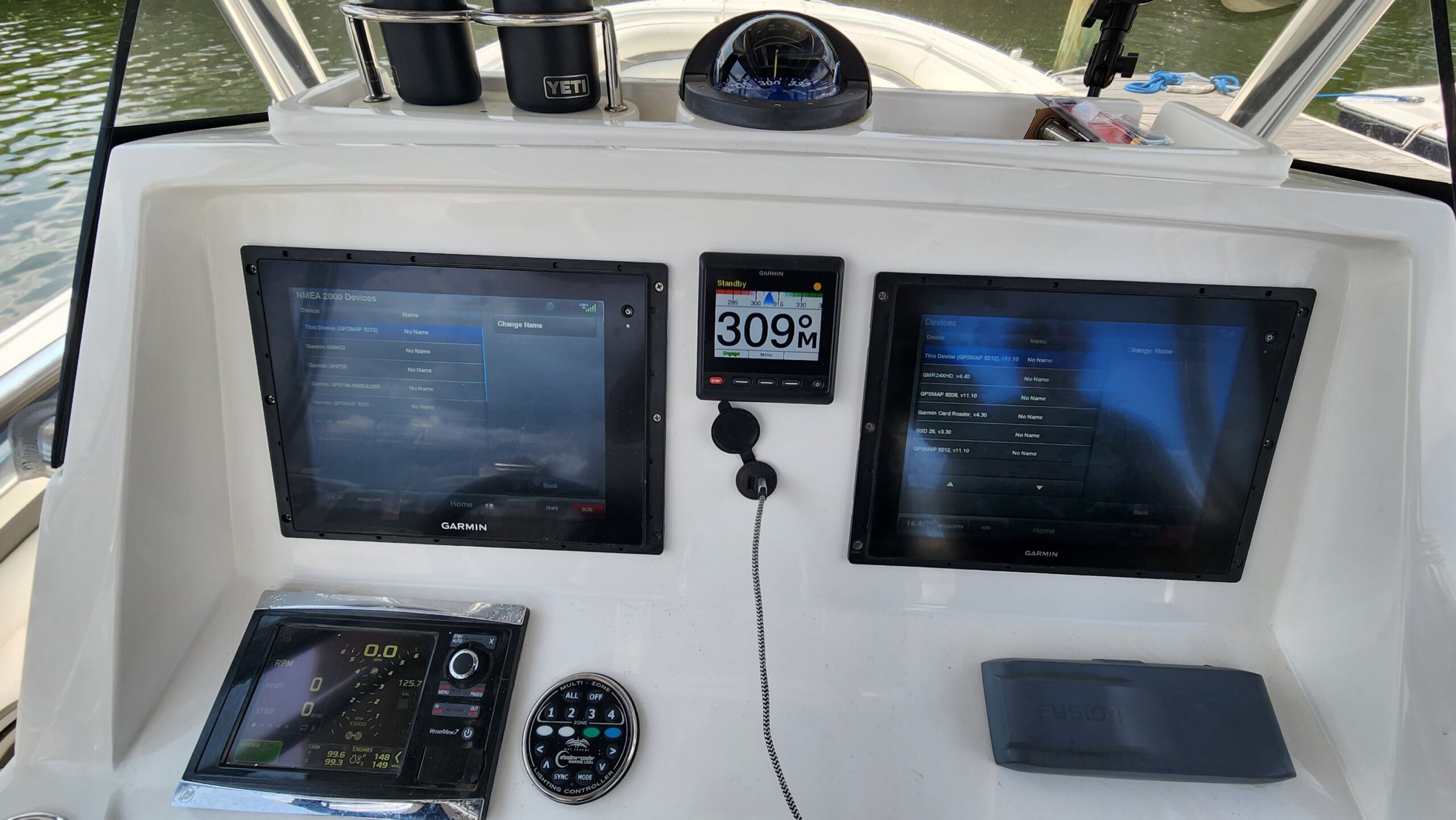
Boat autopilot installation on Long Island.
Garmin, Raymarine and Simrad autopilots installed, networked and sea-trialled at your slip.
LIME handles the electronics side of boat autopilot installation: course computer, heading sensor, control head, rudder feedback and the NMEA 2000 link to your chartplotter, then setup and sea trial. The drive unit or hydraulic pump is steering work, installed by a steering rigger or your dealer.

What We Install
Boat autopilot installation: the parts that do the thinking.
An autopilot is a small system, not one box. A heading sensor knows which way the bow points, a course computer decides how much wheel to put on, a drive turns the steering, and a control head sits at the helm. Tied into the chartplotter over NMEA 2000, it can follow a route you drew on the screen.
We install and set up everything except the drive. An autopilot that snakes or hunts usually traces back to a badly placed sensor, weak power or an unfinished setup.

Course Computer
The brain. Mounted dry, fed from its own DC breaker with cable sized for the pump current.
Heading Sensor
The compass the autopilot steers by. Its spot decides how well the boat holds a course.
Control Head
Garmin GHC, Raymarine p70s or Simrad AP-series at the helm, plus a second station on a tower or flybridge if you want one.
Rudder Feedback
A small sensor on the rudder or steering arm, so the computer knows where the rudder actually is.
NMEA 2000 Integration
Heading, GPS and routes shared with your plotter. Heading on the network also makes radar overlay work properly.
Commissioning & Sea Trial
Dockside setup, then calibration and tuning on the water. It is not finished until it steers.
Garmin · Raymarine · Simrad
Match the autopilot to the screens you already have.
Put in the same brand of autopilot as your chartplotter. Heading and position cross brands over NMEA 2000, but route following and steering from the screen generally stay inside one brand.
Garmin
GHP Reactor kits with GHC 20 or GHC 50 control heads. The heading sensor is usually built into the course computer, so its spot matters.
Raymarine
The Evolution range: the EV unit is heading sensor and course computer in one, with p70s or p70Rs heads at the helm.
Simrad
NAC course computers, the Precision-9 heading sensor and AP-series controllers, or control from an NSS or NSX display.


Your Kind Of Boat
Outboard, inboard or sterndrive: what changes.
The electronics barely change from boat to boat. The steering does.
Outboard boats
Single outboards with hydraulic steering are the most common job: the rigger adds the pump, we do the rest. Twins and triples with electronic power steering, such as SeaStar Optimus, often need no pump at all, because the autopilot steers through the steering system over the network.
Cable steering needs a mechanical drive or a change to hydraulic first. On center consoles, the batteries and speakers packed into the console make the heading sensor spot the main job.
Inboard and sterndrive boats
Mostly hydraulic steering, so there is a pump, plus a rudder feedback sensor on the rudder arm or steering linkage. Cable runs to the lazarette are longer, and flybridge boats usually want a second control head upstairs.
Pod drives and engine joystick systems steer through the engine maker's own system. The autopilot connects over the network, and the engine dealer handles their side.


Drives & Pumps
What we install, and what goes to your rigger.
The drive is the part that physically moves the rudder: usually a hydraulic pump teed into the steering lines, sometimes a linear or rotary drive bolted to the steering linkage. Either way it is part of your steering, and a mistake there can cost you your steering, not just your autopilot.
So we do not install drives or pumps. A hydraulic steering rigger or your dealer does that part, including plumbing, bleeding and leak checks, arranged by you; we schedule around their work. Every estimate says it in writing: drive unit or pump installation, steering plumbing, bleeding and any mechanical steering work by others; LIME is not responsible for steering-side work.
Everything else is ours: course computer, heading sensor, control head, rudder feedback, a DC power feed on its own breaker, NMEA 2000, setup and sea trial. LIME supplies the equipment we install, and power comes off the DC panel, never the AC panel.


The Part Most Installs Get Wrong
Why heading sensor placement matters.
An autopilot steers only as well as it knows where the bow points. The heading sensor is an electronic compass, thrown off by anything magnetic or carrying current nearby.
Away from magnetic noise. Clear of engines, batteries, speakers, heavy DC cables and steel. A speaker magnet a foot away can cause trouble.
Low and near the middle. Near the center of the boat's motion it feels less roll and pitch. Mounted high or at the transom, it swings and the autopilot chases the motion.
Level and lined up. Square to the centerline, level, and on something that does not flex.
The good spot is rarely the easy one. A boat that wanders a few degrees each way, or turns well one way and not the other, is often telling you the sensor is in the wrong place.
Ready to talk? Or keep reading below.
Commissioning
The sea trial is where boat autopilot installation gets finished.
Wiring is half the job; the other half happens on the water. You or your captain drive, and we work the screens.

1. Dockside setup
Boat type, drive type and rudder limits entered, the network checked and the rudder feedback centered.
2. Compass calibration
Slow circles so the sensor can cancel the boat's own magnetic field, then the heading is lined up against GPS.
3. Learning the boat
The autopilot learns how the boat answers the helm at slow speed and on plane.
4. Proving it
Holding a heading, following a route and handing control back to the wheel. We stay until it steers properly.
What It Costs
Boat autopilot installation cost: time and materials.
We never quote a fixed price. The first hour is a flat $280 for one installer, and that includes travel to your boat up to 30 minutes each way plus setup. After that it is $140/hr, billed in 15-minute steps. There is no minimum, no trip fee and no separate setup line. A two-man crew is $440 for the first hour, then $220/hr. Extra travel past 30 minutes each way is $40 per half hour per man, door to door.
For a sense of scale only: the electronics side on a straightforward center console is usually around one working day for one installer, roughly $1,100 to $1,300 in labor, with the sea trial billed on the time it takes. Long cable runs or a second control head take longer. Equipment is supplied by us at cost plus markup, and the rigger or dealer bills separately for the drive side.
Email the boat, steering type, chartplotter model and a helm photo, and we will tell you what the job involves. You pay for the work actually done, never a padded fixed quote.


Where We Work
Nassau, Suffolk and the East End.
We come to the boat anywhere in Nassau and Suffolk, including the East End: Sag Harbor, Montauk, East Hampton and Shelter Island. Usually on your boat within two to three days.
When you call LIME, you get the person doing the work. Labor carries a 60-day warranty; equipment carries the manufacturer's warranty.
Customer Reviews
Five-star reviews from Long Island boat owners.
Verbatim Google reviews. We do not write our own.
★★★★★ Christopher K.
“Dave and Adam did a great job installing my new trolling motor, heading sensor, batteries, switch, and charger. They even modified my bow rail for the motor to deploy. They were easy to work with and the project turned out great. I recommend LIME very highly.”
★★★★★ Frank S.
“I had my marine electronics installed by Dave and did a great job. I especially appreciated that the final price matched the estimate, no hidden costs. Had him come back a year later for assistance in updating software. Overall a great experience.”
★★★★★ Tommy C.
“On time. Knowledgeable. Dependable. Reasonable.”
FAQ
Boat autopilot installation: common questions.
Do you install the autopilot pump or drive unit?No, and we say so in writing before work starts. The drive or hydraulic pump is part of your steering, so a steering rigger or your dealer installs, bleeds and leak-checks it, arranged by you. We do the electronics side and schedule around their work.
No, and we say so in writing before work starts. The drive or hydraulic pump is part of your steering, so a steering rigger or your dealer installs, bleeds and leak-checks it, arranged by you. We do the electronics side and schedule around their work.
Which autopilot brands do you install?
Garmin (GHP Reactor with GHC control heads), Raymarine (Evolution with p70s and p70Rs controllers) and Simrad (NAC computers with the Precision-9 sensor and AP-series controllers). We usually match your chartplotter brand, and LIME supplies all the equipment we install.
Can the autopilot work with my existing chartplotter?
Usually. With the same brand you can follow a route and see autopilot status on the plotter. Mixed brands share heading and position, but steering one brand from another’s screen usually is not possible.
Where does the heading sensor go?
Low, level, near the middle of the boat and away from anything magnetic: engines, batteries, speakers, heavy DC cables and steel. We pick the spot before anything is mounted, because a badly placed sensor makes the boat wander.
What happens on the sea trial?
Dockside setup, then on the water: you or your captain drive while we calibrate the compass, align the heading with GPS and let the autopilot learn the boat, then test heading hold, route following and handing back to the wheel.
How much does boat autopilot installation cost?
Time and materials, never a fixed price: $280 for the first hour with travel up to 30 minutes each way included, then $140/hr in 15-minute steps, no minimum. Equipment is at cost plus markup. The rigger or dealer bills separately for the drive side.
Can you put an autopilot on an outboard boat?
Yes. With hydraulic steering the rigger adds the pump and we do the rest. Twins and triples with electronic power steering often need no pump at all. Cable steering needs a mechanical drive or a change to hydraulic first, which is steering work for the rigger or dealer.
How soon can you come, and does the boat need to be hauled?
Usually on your boat within two to three days, and the boat stays in the water. The electronics side is often a day’s work, and the sea trial happens once the drive side is finished, so plan on two visits.
Get Started
Ready for an autopilot that actually holds a course?
Send the boat, steering type and chartplotter model. We will tell you what the job involves and who does which part.
$280 first hour, travel included · $140/hr after · No minimum · Time and materials